Українська | Русский | Deutsch | English

COMMUNICATION SKILLS AND PUBLIC SPEAKING
for 9-16 years old
Imagine you are 15. What would
you wanted to learn?
- Is it better to manage your emotions during conflicts?
- Recognize manipulation and deception?
- Confidently speak to the public?
- Keep the interest of peers in the process of communication?
It is with these useful Soft Skills that you will get acquainted
the Course "Communication and Public Speaking"

TRAINER OF THE COURSE
SVITLANA GORBACH
Let's get acquainted!
I am Svitlana Gorbach, founder of EveRRest Alternative School in Ukraine and Soft Skills Schule in Germany. For more than 20 years I have been creating courses for forging universal skills (Soft Skills) that help children and adults in different life situations. 🚀
The course "Communication Skills and Public Speaking" is extremely important for teenagers, because at this age they actively form connections and develop their own opinion. These skills will help them to speak more confidently, overcome the fear of public speaking and interact more effectively with others.
The course program covers three key circles of communication:
- Family circle (interaction of a teenager with his family: parents, brothers, sisters)
- Social circle (communication with friends and acquaintances, as well as meeting new people)
- Public circle (performances in front of the audience)
These three areas cover the main spectrum of communication between adolescents in this age period. They highlight potential points of tension in communication and provide us, adults, with important information about what is happening in the inner world of the child during his rapid growing up. This is a unique and extremely important period when the foundations of the most important skills necessary not only for training, but also for a future career and successful self-realization are laid.
See you on the course! 👋
This course is vital for a teenager
If he:
- Active, likes to try something new, wants to develop himself and be successful among peers.
- He wants to learn to speak in public more confidently, to overcome his anxieties.
- He does not feel confident when communicating with other people, meeting new companies, adapting to new teams.
- He has difficulty controlling his emotions, which often causes disputes and conflicts in your home and beyond.
If you:
- It is important to support him on the way of growing up and allow him to master soft skill, knowledge of which is not given at school.
- Significantly, the teenager was able to reasonably prove his position, and negotiated, hearing others, and not just emotional.
- You want to protect him from the "bad influence" - to increase the skill of filtering information, the ability to say no, see lies and resist manipulation.
- You want to increase his confidence in himself and his abilities, develop emotional intelligence and basic communication skills of a teenager.
COURSE PROGRAM
Lecture 1. Your strengths and weaknesses in communication
- 7 strategic communication skills;
- My level of development of these skills;
- 3 zones of the nearest development in the field of communication.
Lecture 2. Win-Win strategy. Conflict Resolution
- 5 types of behavior in conflict. Which one do I choose?
- Which reduces, which increases the degree of conflict;
- 5 conflicting personality types how to interact with them.
Lecture 3. Control of emotions during communication
- How to reduce negative emotions in the "Here and Now" situation?
- Liberation from post-experiences (we reduce the intensity of negative emotions: resentment, aggression/anger, sadness);
- My personal ecological way of dealing with negativity.
Lecture 4. Confident position in disputes
- Strategies and tactics of discussion;
- 6 main ways of argumentation;
- How to admit if you are wrong?
Lecture 5. Manipulation and deception
- Manipulation - how to determine and how to act;
- How to recognize a liar? 8 types of manipulators;
- How to achieve your without manipulation and deception?
Lecture 6. Communication with family, friends, acquaintances
- 3 roles in the process of communication;
- "I am interesting" - 5 ways to maintain a lively conversation;
- How to establish contact with an unfamiliar person?
Lecture 7. Public Speaking
- 5 rules of successful performance;
- How to keep the attention and warm the interest of the audience
- How to calm down before the performance.
Lecture 8. Transformational game "Geniuses of negotiations"
Game-training, aimed at the study of communicative skills acquired during the course. It will allow teenagers to test and improve their skills, in the course of various situations that will set the playing field. Through the game, teenagers will train their skills:
1. Quickly find significant arguments explaining your point of view;
2. Illustrate your statements through comparisons, metaphors and schemes;
3. Respond to the tactlessness of the interlocutors without "hits" and aggression;
4. Keep an equal footing and keep a "sober" mind in non-standard communication situations;
5. Verbally influence the group to get the desired result, without the use of manipulation.
LEARNING FORMATS: live lessons 1 once a week
Zoom training with a teacher

16 lessons of 40 minutes
Tests, quizzes,
projects
Certificate
of passage

Chat support for children and parents
SPRINT-COURSE: independent education
16 educational
video
Guides to self-organization
Tests, quizzes for
self-control
Individual pace of passage
Pleasant
price
FREQUENTLY ASKED QUESTIONS
Why do we need parents?
Most parents want their children to be successful and organized. But children learn from examples. I invite you to become the best example and support for your child, showing that productivity and motivation are about joint development.
How does this happen?
At the heart of the course, as always, open questions and life situations, together we find an almost "inventive" solution to розвʼязання a specific life problem of a teenager, get acquainted with cases of famous people and adapted tools of adult time management.
Is 8 weeks enough to form a skill?
The skill is formed 21 days, and we have as many as 56! After the course, you will have checklists with all the tools for self-organization, planning and self-control, useful video tips and the desire to purge positive changes.
If I missed classes?
You can review the lesson in the record, get all the necessary materials and my personal support.
Hot 🔥 offer is valid only but New Year
Offer expired...
SCHOOL COURSE
training with a trainer
€96 €122
SPRINT-COURSE
self-study
€34 €48
MINI-COURSES
- Speed reading
- Life hacks of memory
- Smart notes
How to join live trainings?
Application and meeting with parents

We will contact you within the working day after submitting the application.
After confirming participation, we appoint an individual meeting with the course coach.
We coordinate:
- course payment options
- training schedule
- communication channels
Individual meeting with a teenager

Before the start of the course, the teenager will meet with the tete-a-tete coach 1 time (at the meeting there will be zero diagnosis of flexible skills and "removal" of the child's request). It is important for us that the teenager understands what will happen on the course and where he will be able to apply this knowledge. The results of the diagnosis are given to him on the program.
Main cycle
classes

6 courses of 16 classes, held in stages, but you can start with any course. In the programs of each course, tests, group training exercises, brainstorming sessions and transformational games.
In addition, all participants will receive lesson guides, where the most important thing is concentrated so that, even later, they can refresh their memories.
How to join sprint training and mini-courses?
Application
and payment
You leave an application and go to the course chatbot
Pay in a convenient way for you
Zero diagnosis of
flexible skills
After confirming the payment, zero diagnosis opens to you. It will help you see the level of formation of flexible skills and growth perspectivity
Main cycle of
classes
You move on to learning. Lessons are opened to you in turn. After passing the lesson, you perform a mini-test and proceed to the next lesson.
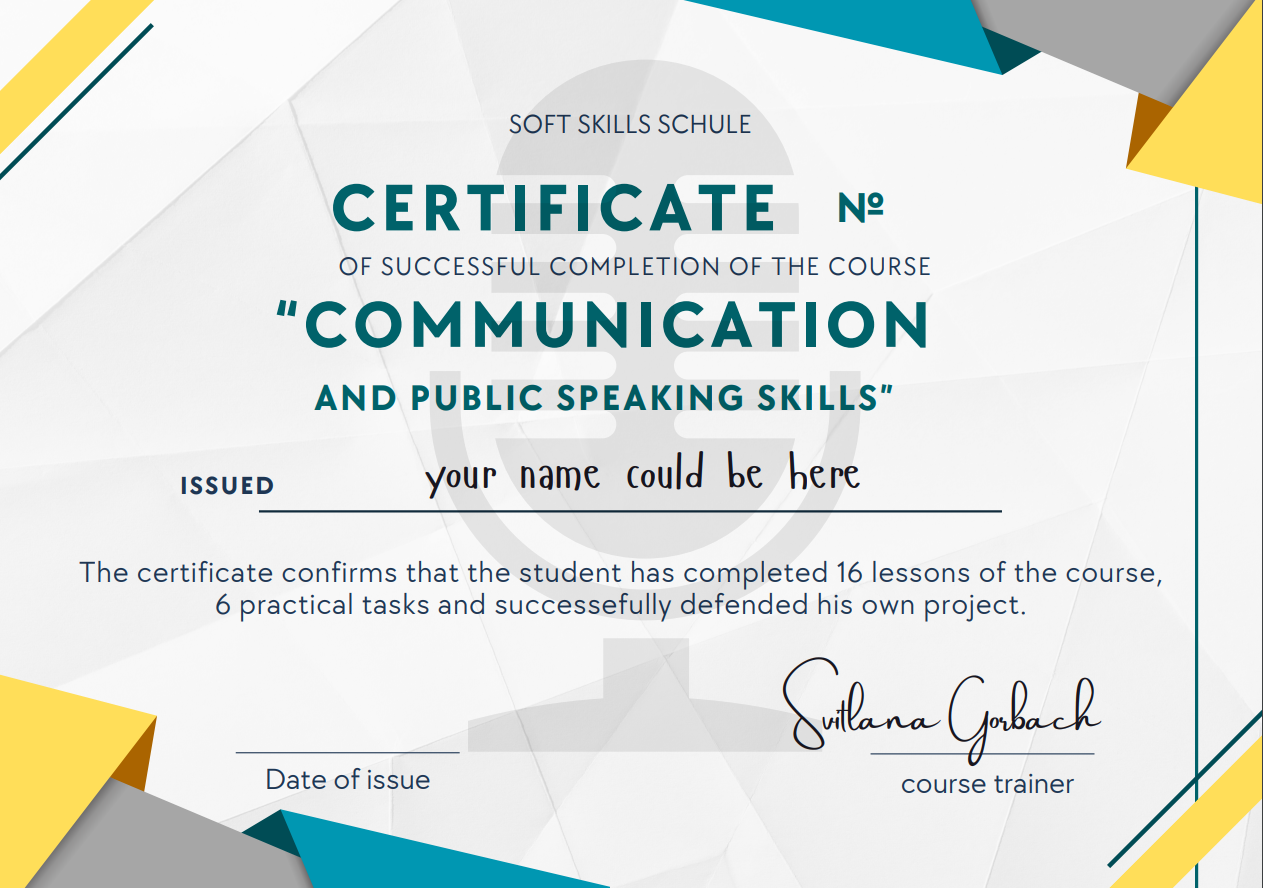
At the end of the course, Soft Skills Schule students will receive a certificate
(subject to all practical tasks and project protection)
Contact us if you have any questions!
Telegram | Viber | WhatsApp
+38 (096) 387 17 06 🇺🇦
+49 (171) 74 18 264 🇩🇪
Email address:
softskillsschule@gmail.com